Force of Warships: Ship Games
- 4.3
- Rating
- 5.00M
- Installs
- Free
- Price
 Analysis by App-foxy
I spent time with Force of Warships: Ship Games to see whether its modern naval battles offer more than a quick burst of excitement. It is a free action game from XDEVS LTD, built around controlling warships in competitive battles and sharing that experience with friends. The first sessions are easy to understand: choose a ship, enter a fight, move into position, and look for a chance to damage the opposing fleet.
That straightforward start is a real strength. I did not need a long tutorial or specialist knowledge of naval warfare to begin making useful decisions. At the same time, the game is not simply an arcade shooting gallery. Positioning, timing, target selection, and the condition of your ship all affect how a battle develops. The interesting question is not whether it can entertain me for an evening, but whether it deserves a regular place on my phone after the novelty of commanding a large warship wears off.
Why the first week feels so engaging
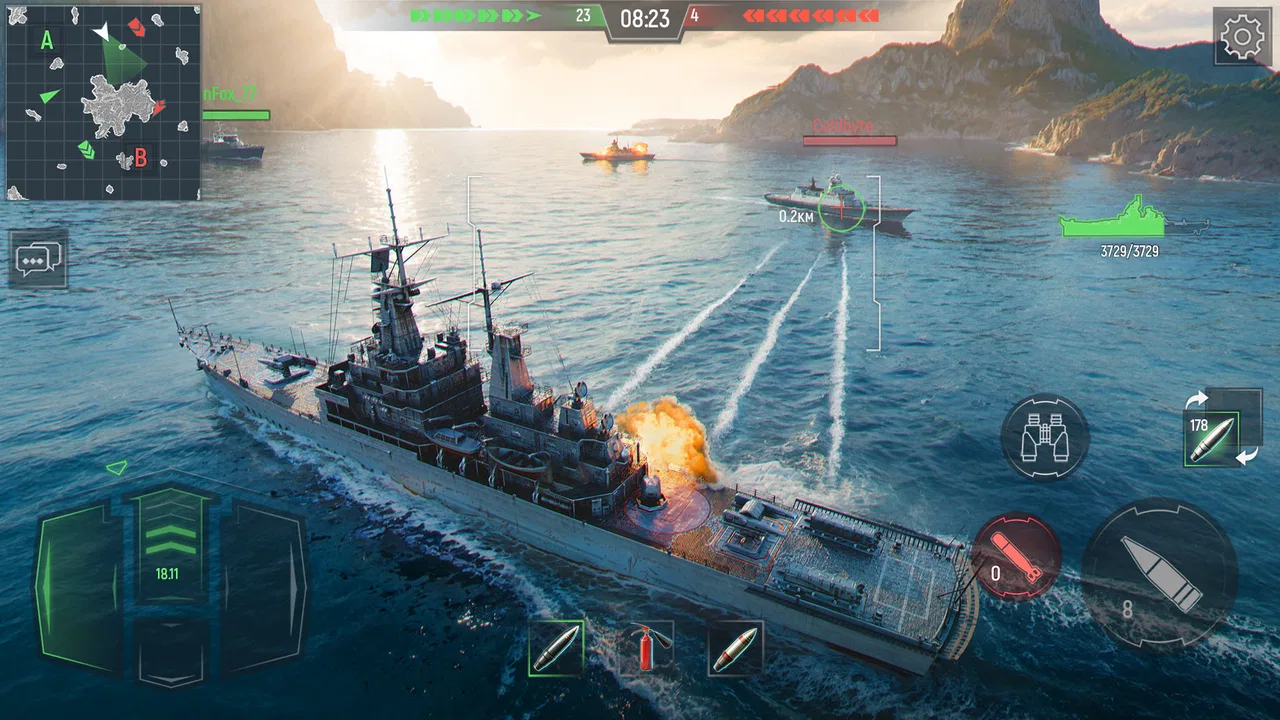
The strongest part of the opening week is the sense of scale. A phone screen becomes a small command deck, and even a short match can feel dramatic when ships are moving, weapons are firing, and several opponents are competing for the same space. The action is immediate enough for casual play, but there is also room to think before committing to a direction.
You May Also Like

 Blood Strike: 2.5 Anniversary
Blood Strike’s Loadouts Turn Every Drop Into a Tactical Gamble
A close look at Blood Strike’s custom loadouts: how fast access to signature weapons reshapes its battle royale rhythm, rewards preparation, and narrows the gap between fights.

 Pandora - Music & Podcasts
Pandora’s Music Is Easy to Start, but Harder to Recover
Pandora’s strength is its low-effort path from a seed to a station. Its weak spot is how much confidence it asks you to place in connection, setup, and quiet recovery.

 8 Ball Pool
 Is Built on Rivalries, Rematches, and Routine
A close look at the rivalries, rematches, shared routines, and unanswered safety questions that turn a quick pool match into a persistent mobile community.

 Samsung Music
’s Quiet Strength Is Playing What You Already Own
Its reach comes less from spectacle than from dependable access to a personal library. That simplicity is both the app’s strongest retention engine and its ceiling.

 AccuWeather: Weather Radar
AccuWeather Review: A Quick, Clear Forecast for Everyday Decisions
For everyday plans, the best forecast is the one you can understand quickly. AccuWeather makes rain timing, radar, and local conditions easy to act on, with a few trade-offs.

 Hill Climb Racing
Why Hill Climb Racing Still Turns Crashes Into One More Run
A tiny car, a bumpy hill and one more upgrade: Hill Climb Racing keeps resurfacing because its simple chaos makes every near-miss feel personal.
More From Our News Desk



I found the early battles especially suitable for players who like action games but do not want a complicated control scheme. The basic loop is readable: steer, observe the battlefield, choose a target, attack, and react to incoming pressure. That makes it a comfortable game to pick up during a break. You can start without first learning a large set of character abilities or a long sequence of button combinations.
The naval setting also gives the game a different personality from the usual mobile action alternatives. Instead of running through a compact arena as an individual character, I have to think about a vessel with momentum and a broader presence. That changes the rhythm. Turning too late can leave me exposed, while moving too aggressively can make it difficult to recover when the battle shifts.
The social angle matters during this stage. The game is designed around joining battles with friends, and coordinated play gives the matches a clearer purpose than simply chasing personal damage. Even a basic plan, such as staying near an ally or focusing attention on the same opponent, can make a team feel more organized. Players who enjoy discussing tactics while playing will get more from it than people who treat every match as a completely solo activity.
One useful habit I developed quickly was watching the overall movement of the battle instead of staring only at the nearest target. A ship may look vulnerable, but attacking it can pull me away from a safer position or expose me to another opponent. This is one of the first signs that the game has more decision-making than its simple controls suggest.
The first week is also when the variety of ships and progression is most exciting. Unlocking or improving a vessel creates a reason to play another match, and the idea of building a stronger fleet is easy to understand. I like that the reward loop is connected to the central fantasy rather than being an unrelated collection of cosmetic tasks. The downside is that progression can make early victories feel more important than they really are, because a loss may seem to delay the next improvement.
For a free game, the entry point is attractive. There is no purchase required to try the core experience, and the age guidance places it at Everyone 10+, which makes it approachable for a broad audience. The game has reached over five million installs, with an average rating of 4.3 from around eighty-nine thousand ratings, so it clearly has an established audience rather than being an obscure experiment.
Still, those figures do not tell me whether every player will enjoy the same pace. Someone who wants constant, high-speed movement may find naval combat less immediately thrilling than a character-based shooter. The ships feel more deliberate, and that deliberate movement is either the appeal or the obstacle depending on what I want from an action game.
Small decisions that improve early matches
My best early advice is to avoid treating the first available target as the only target. Before firing, I try to check whether the attack will leave my ship isolated, whether an ally is already pressuring that opponent, and whether another enemy is moving into a better position. This simple pause often produces better results than firing as soon as a weapon becomes available.
I also recommend learning one ship properly before constantly switching between vessels. Different ships can encourage different approaches, and changing too often makes it difficult to understand whether a poor result came from the ship, the situation, or my own decision. A short period of consistency helps reveal which play style actually suits me.
Another practical tip is to treat movement as part of defense rather than as a way to reach the action. A ship that is always advancing may look active, but it can become an easy target if it loses support. I had better matches when I considered escape routes before entering a fight. That is a small tactical detail, but it separates the game from a button-mashing experience.
What remains after the novelty fades
After the first rush, the game’s long-term value depends on whether I enjoy repeating the same basic cycle with improving judgment. The battles remain accessible, but accessibility can become repetition if the surrounding progression does not give me a meaningful reason to return. For me, the lasting appeal comes less from discovering the controls and more from trying to play each engagement with fewer careless decisions.
The game works best as a regular short-session activity. I can imagine opening it when I have enough time for a few battles, rather than reserving an entire evening for a long campaign. That makes it convenient, but it also means the game has to make each session feel worthwhile. A poor run of matches can feel more noticeable when there is no separate story mode or exploration layer to change the mood.
Playing with friends improves the month-to-month experience because teamwork creates new situations. A familiar group can experiment with who takes the lead, who provides support, and when to disengage. Even if the underlying controls stay the same, communication adds variation. Without that social element, the game relies more heavily on personal goals and fleet progression to keep the routine fresh.
This is where I see an important trade-off. Players who enjoy competitive repetition may find a satisfying training curve: they can review mistakes, improve positioning, and become more reliable in team battles. Players who need frequent new mechanics, narrative chapters, or large changes in scenery may feel the routine settle too quickly. The game’s value is therefore tied to the kind of motivation I bring to it.
The current version is 7.02.0, and that makes maintenance relevant to the experience. A live mobile game needs regular attention from its developer to remain comfortable over time, especially when players return repeatedly for competitive matches. I judge that maintenance not only by new content, but also by whether the game remains easy to understand, whether matches feel fair, and whether progression continues to give ordinary play a purpose.
I would not recommend approaching the game as a guaranteed substitute for a full console or computer naval simulator. It is designed for mobile action, so the appeal is quick access and manageable controls rather than exhaustive realism. Compared with a traditional strategy game, it asks for faster reactions and shorter decisions. Compared with a typical arena shooter, it offers slower movement and a stronger emphasis on positioning a large unit.
The free entry point is helpful for testing that fit. However, in-app purchases range from $0.99 to $114.99 per item, so I would set a personal spending limit before getting deeply involved in progression. The presence of purchases does not automatically ruin the game, but it can change how I evaluate improvements and rewards. If I start feeling that progress is pushing me toward spending rather than rewarding play, the experience becomes less relaxing.
My practical approach is to play first without buying anything, learn which ships and battle habits I genuinely enjoy, and only then decide whether an optional purchase adds value. This prevents the common mistake of spending early because the first week feels exciting. A purchase can make sense for someone already committed to the game, but it is harder to justify when I am still unsure whether I will return next month.
Where the monthly routine can become tiring
The main source of fatigue is repetition without a clear personal objective. If every session becomes a search for the next upgrade, the battles may start to feel like a task rather than a game. I get more value when I create a small goal for myself, such as improving my survival decisions, supporting teammates more consistently, or learning how to recognize a losing position earlier.
Another source of friction is the emotional effect of team battles. A strong personal performance cannot always rescue a disorganized group, and a poor result may not be entirely my fault. That can be frustrating when I am trying to make steady progress. Friends reduce this problem because communication makes losses more understandable and victories more satisfying.
The game may also be a poor fit for anyone who dislikes progression systems connected to optional spending. The price range of individual purchases is wide enough that budget-conscious players should remain alert. I appreciate being able to try a free action game, but I would not tell a friend to enter the game with an open-ended spending mindset. The safest way to enjoy it is to decide in advance what role it should have on the phone.
There is also a maintenance burden on the player’s side: attention. Naval combat rewards watching the whole field, and that is harder to do when I am distracted or trying to play while multitasking. A quick match may fit into a break, but it still deserves concentration if I want to make good decisions. For completely passive play, this is the wrong choice.
On an everyday level, I can see two very different use cases. During a short commute or a quiet break, I could play a few battles and stop without needing to remember a complicated story. On the other hand, if I am tired and only want effortless entertainment, the need to monitor positioning and team pressure may feel like work. The game fits focused short sessions better than half-attentive scrolling.
Who should install it and who should skip it
I would recommend it to players who like mobile action with a naval identity, gradual improvement, and the possibility of coordinated battles with friends. It is particularly appealing if I enjoy learning through repeated matches rather than needing a large amount of new content every time I open a game. The controls are approachable, while the best results still require judgment.
I would be more cautious recommending it to someone who wants a deep single-player campaign, realistic simulation, or a completely purchase-free progression experience. It is also not ideal for players who become discouraged by team losses or who prefer games where every outcome depends only on their own performance. A solo puzzle game or a story-focused adventure would be a better alternative for those needs.
Compared with other mobile action games, its clearest advantage is the feel of commanding a warship rather than controlling a small individual avatar. That gives battles a slower, more positional character. Its weakness is the same: anyone expecting rapid movement and constant close-range action may find the ships too measured. The right comparison is not “which game is universally better,” but whether I want tactical naval movement or a faster conventional arena.
For friends deciding whether to play together, I would suggest agreeing on a simple team plan before entering a battle. It does not need to be complicated. Choosing who will stay together, identifying when to retreat, and avoiding several players chasing different targets can make the game feel more cooperative immediately. This is one of the most useful ways to create fresh value without waiting for a new feature.
My long-term verdict on Force of Warships
After the initial novelty, Force of Warships: Ship Games earns continued space on my phone only if I approach it as a repeatable competitive habit, not as a one-time showcase of modern ships. Its strongest qualities are the clear naval theme, approachable action, and the extra depth created by movement and team positioning. It is easy to begin, but playing well asks for more care than the first battles suggest.
I like the fact that it can serve different levels of commitment. I can play casually for a few short sessions, or I can focus on improving how I read the battlefield. Friends add a valuable layer, and the game’s free price makes experimentation simple. The age rating of Everyone 10+ also makes it a relatively accessible recommendation for families and younger players who enjoy action games, while the developer remains clearly identified as XDEVS LTD.
My reservations are equally clear. Repetition can take over if I do not set my own goals, team outcomes can be frustrating, and the in-app purchase range means I should manage spending rather than play impulsively. Players seeking a substantial story or a highly realistic simulation should look elsewhere. Even fans of action games may lose interest if they need constant mechanical change.
For me, the deciding factor is whether the tactical rhythm feels satisfying on a given day. When I want a mobile battle that rewards patience, awareness, and cooperation, this game has a convincing reason to return. When I want effortless action or a dramatic solo adventure, it does not meet that need. The lasting value comes from improving how I play, not from novelty alone.
My final recommendation is to install it, try the early battles without rushing into purchases, and pay attention to how you feel after several sessions rather than judging it from the first victory. If you enjoy the process of reading a fleet battle and working with friends, it can become a dependable action game. If the repeated naval encounters already feel routine during the trial period, no amount of progression is likely to turn it into the right long-term choice.
FAQs for Force of Warships: Ship Games
01What is Force of Warships: Ship Games?
Force of Warships: Ship Games is a mobile naval combat game focused on modern warships, fleet battles, and competitive missions. After launching it, you can choose and upgrade different vessels, equip weapons, and fight opponents in action-oriented matches. The game combines real-time combat with progression systems, so success depends on both aiming and building a capable fleet.
02Can Force of Warships: Ship Games be played offline?
The game is primarily designed for online play because its main features involve connected battles, account progression, events, and interaction with other players. Some menus or limited activities may remain accessible without a connection, but you should not expect the complete gameplay experience offline. A stable Wi-Fi or mobile-data connection is recommended before downloading updates or entering battles.
03Is Force of Warships: Ship Games free to download?
Force of Warships: Ship Games is generally available as a free download, but it may include optional in-app purchases. These purchases can provide resources, upgrades, premium items, or other shortcuts that help with progression. You can play without spending money, although advancing your fleet may require more time and patience. Check the store listing for current pricing and purchase details.
04What devices are compatible with Force of Warships: Ship Games?
Compatibility depends on the operating system, device model, available storage, and the minimum software version required by the current release. Because naval battles include detailed graphics and online effects, older phones may experience slower performance, longer loading times, or reduced visual quality. Before installing, review the official Google Play or App Store requirements and keep enough free space for updates.
05Does Force of Warships: Ship Games require skill, or is it mainly pay-to-win?
The game rewards practical skills such as positioning your ship, choosing suitable targets, managing weapons, and understanding each vessel’s strengths. However, progression and optional purchases can influence how quickly players obtain stronger ships or equipment. This means free players can still enjoy battles, but competing at higher levels may require regular play, careful upgrades, and potentially more patience than players who spend money.
Pros
- Large selection of modern warships to unlock and upgrade.
- Fast-paced naval battles are easy to start and understand.
- Multiple game modes add variety beyond standard team matches.
- Detailed ship models and effects make battles visually engaging.
- Regular events provide extra objectives and limited-time rewards.
Cons
- Progression can feel slow without spending money or saving resources.
- Matchmaking may place newer players against much stronger ships.
- Energy or battle limits can interrupt longer play sessions.
- Some upgrades and rewards rely heavily on random drops.
- Online connection is required for most gameplay features.

Force of Warships: Ship Games
Gallery